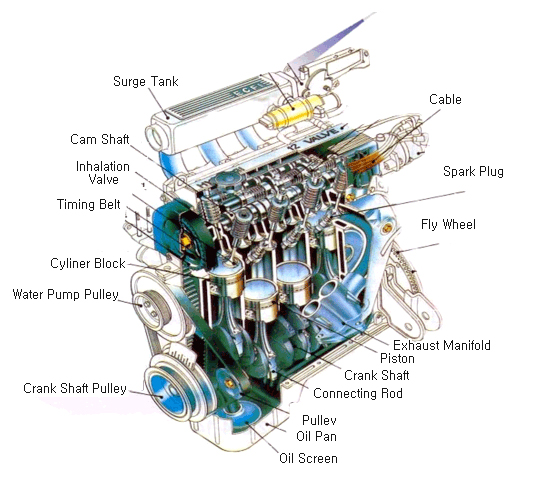
The camshaft is an apparatus often used in piston engines to operate poppet valves. It consists of a cylindrical rod running the length of the cylinder bank with a number of oblong lobes or cams protruding from it, one for each valve. The cams force the valves open by pressing on the valve, or on some intermediate mechanism, as they rotate.
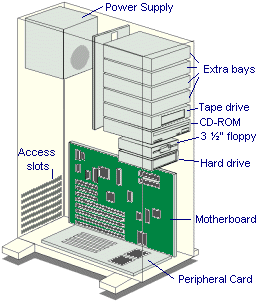
A motherboard is the central printed circuit board (PCB) in some complex electronic systems, such as modern personal computers. The motherboard is sometimes alternatively known as the mainboard, system board, or, on Apple computers, the logic board.[1] It is also sometimes casually shortened to mobo.[2]
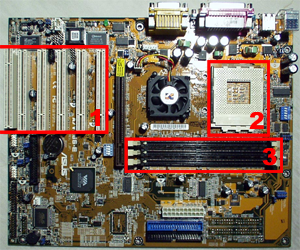
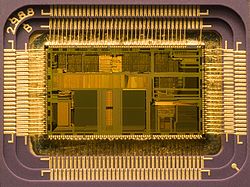
A central processing unit (CPU) is an electronic circuit that can execute computer programs. This broad definition can easily be applied to many early computers that existed long before the term "CPU" ever came into widespread usage. The term itself and its initialism have been in use in the computer industry at least since the early 1960s (Weik 1961). The form, design and implementation of CPUs have changed dramatically since the earliest examples, but their fundamental operation has remained much the same.
Early CPUs were custom-designed as a part of a larger, sometimes one-of-a-kind, computer. However, this costly method of designing custom CPUs for a particular application has largely given way to the development of mass-produced processors that are suited for one or many purposes. This standardization trend generally began in the era of discrete transistor mainframes and minicomputers and has rapidly accelerated with the popularization of the integrated circuit (IC). The IC has allowed increasingly complex CPUs to be designed and manufactured to tolerances on the order of nanometers. Both the miniaturization and standardization of CPUs have increased the presence of these digital devices in modern life far beyond the limited application of dedicated computing machines. Modern microprocessors appear in everything from automobiles to cell phones to children's toys
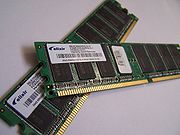
Random-access memory (usually known by its acronym, RAM) is a form of computer data storage. Today it takes the form of integrated circuits that allow the stored data to be accessed in any order (i.e., at random). The word random thus refers to the fact that any piece of data can be returned in a constant time, regardless of its physical location and whether or not it is related to the previous piece of data.[1]
This contrasts with storage mechanisms such as tapes, magnetic discs and optical discs, which rely on the physical movement of the recording medium or a reading head. In these devices, the movement takes longer than the data transfer, and the retrieval time varies depending on the physical location of the next item.
The word RAM is mostly associated with volatile types of memory (such as DRAM memory modules), where the information is lost after the power is switched off. However, many other types of memory are RAM as well (i.e., Random Access Memory), including most types of ROM and a kind of flash memory called NOR-Flash.
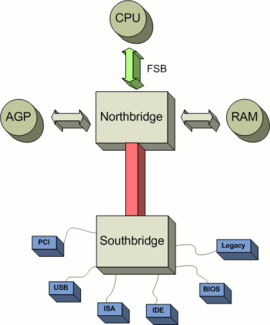
In computing, the term chipset is commonly used to refer to a set of specialized chips on a computer's motherboard or an expansion card. In personal computers the first chipset for the IBM PC AT was the NEAT chipset by Chips and Technologies for the Intel 80286 CPU. Based on Intel Pentium-class microprocessors, the term chipset often refers to a specific pair of chips on the motherboard: the northbridge and the southbridge. The northbridge links the CPU to very high-speed devices, especially main memory and graphics controllers, and the southbridge connects to lower-speed peripheral buses (such as PCI or ISA). In many modern chipsets, the southbridge actually contains some on-chip integrated peripherals, such as Ethernet, USB, and audio devices. A chipset is usually designed to work with a specific family of microprocessors. Because it controls communications between the processor and external devices, the chipset plays a crucial role in determining system performance.
The manufacturer of a chipset often is independent from the manufacturer of the motherboard. Current manufacturers of chipsets for PC-compatible motherboards include NVIDIA, AMD, VIA Technologies, SiS, Intel and Broadcom. Apple computers and Unix workstations from Sun, NeXT, SGI, and others have traditionally used custom-designed chipsets; now that Sun and Apple both have x86 processors in at least some of their lines of products, they have begun to use standard PC chipsets in some of their computers. Some server manufacturers also develop custom chipsets for their products.
In the 1980s, Chips and Technologies, founded by Dado Banatao (who later founded S3 Graphics), pioneered the manufacturing of chipsets for PC-compatible computers. Computer systems produced since then often share commonly used chipsets, even across widely disparate computing specialties. For example, the NCR 53C9x, a low-cost chipset implementing a SCSI interface to storage devices, could be found in Unix machines such as the MIPS Magnum, embedded devices, and personal computers.
In home computers, game consoles and arcade game hardware of the 1980s and 1990s, the term chipset was used for the custom audio and graphics chips. Examples include the Commodore Amiga's Original Chip Set or SEGA's System 16 chipset
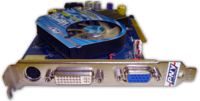
A video card, also known as a graphics accelerator card, display adapter, or graphics card, is a hardware component whose function is to generate and output images to a display. It operates on similar principles as a sound card or other peripheral devices.
The term is usually used to refer to a separate, dedicated expansion card that is plugged into a slot on the computer's motherboard, as opposed to a graphics controller integrated into the motherboard chipset. An integrated graphics controller may be referred to as an "integrated graphics processor" (IGP). For most computer users an integrated controller is sufficient, as it can handle most web applications and e-mail.[1]
Some video cards offer added functions, such as video capture, TV tuner adapter, MPEG-2 and MPEG-4 decoding, FireWire, light pen,TV output, or the ability to connect multiple monitors.
A common misconception regarding video cards is that they are strictly used for video games. Video cards instead have a much broader range of capability. Being specialized for video, output video cards improve what a computer monitor displays. As well, they play a very important role for graphic designers and 3D animators, who tend to require optimum displays for their work as well as faster rendering in order to efficiently tone up their work.
Video cards are not used exclusively in IBM type PCs; they have been used in devices such as Commodore Amiga (connected by the slots Zorro II and Zorro III), Apple II, Apple Macintosh, Atari Mega ST/TT (attached to the MegaBus or VME interface), Spectravideo SVI-328, MSX, and in video game consoles.
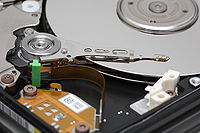
A hard disk drive (HDD), commonly referred to as a hard drive, hard disk, or fixed disk drive,[1] is a non-volatile storage device which stores digitally encoded data on rapidly rotating platters with magnetic surfaces. Strictly speaking, "drive" refers to a device distinct from its medium, such as a tape drive and its tape, or a floppy disk drive and its floppy disk. Early HDDs had removable media; however, an HDD today is typically a sealed unit (except for a filtered vent hole to equalize air pressure) with fixed media.[2]
HDDs (introduced in 1956 as data storage for an IBM accounting computer[3]) were originally developed for use with general purpose computers. During the 1990s the need for large-scale, reliable storage, independent of a particular device, led to the introduction of embedded systems such as RAID arrays, network attached storage (NAS) systems and storage area network (SAN) systems that provide efficient and reliable access to large volumes of data. In the 21st century, HDD usage expanded into consumer applications such as camcorders, cellphones, digital audio players, digital video players (e.g. the iPod Classic), digital video recorders, personal digital assistants and video game consoles.